Stop Over-Complicating Onboarding.
A Simple Approach for Companies Still Chasing Joiners and Leavers If your company uses Personio and Google Workspace, but onboarding still happens via spreadsheets, Slack messages, and tickets, then this article is for you. Not because you lack tools. Not because your team isn’t trying. But because your systems don’t trust each other — so humans are forced to fill the gaps. And that costs time, money, and focus every single week. The Hidden Cost of Manual Onboarding Most onboarding process
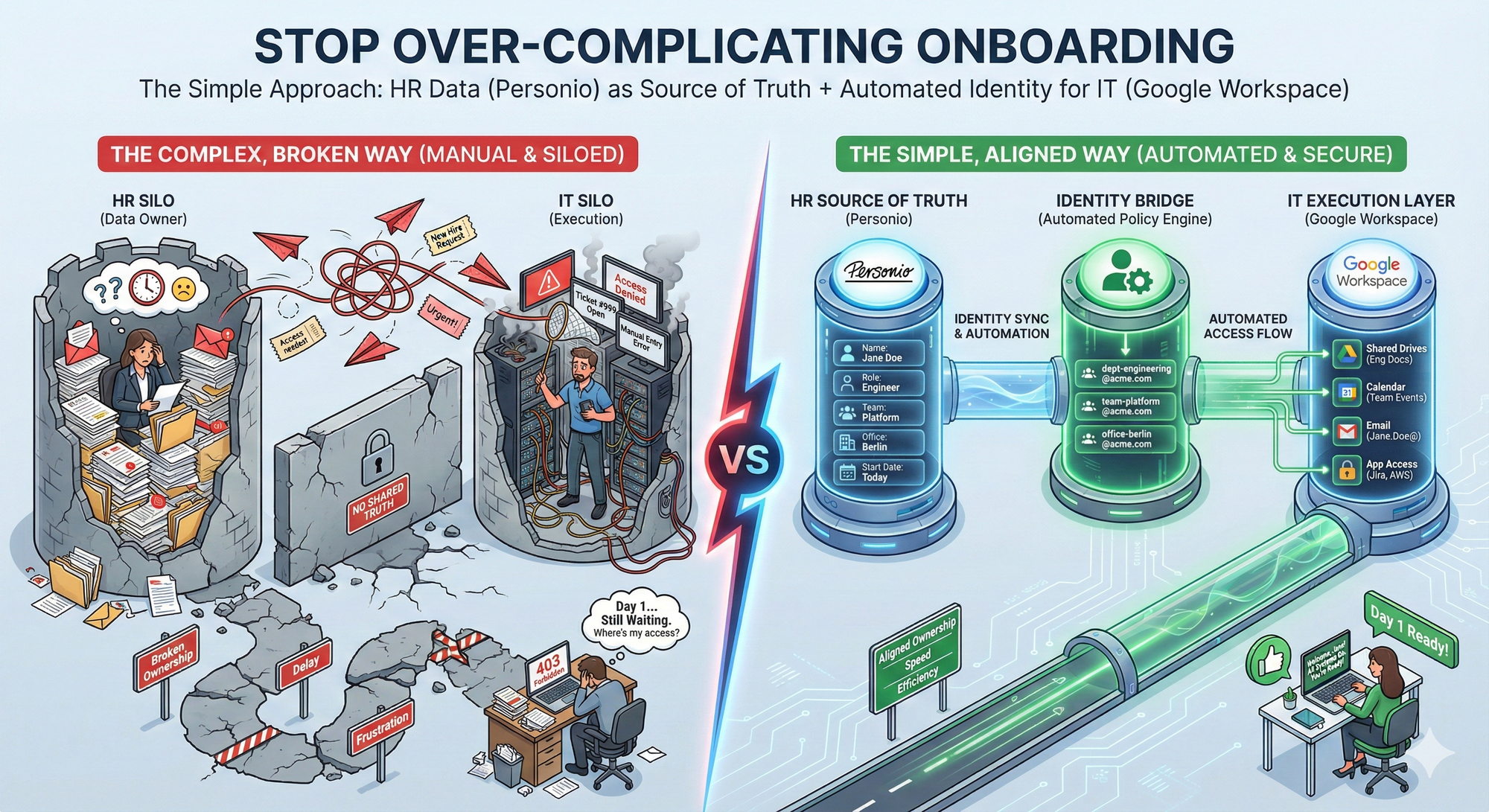
A Simple Approach for Companies Still Chasing Joiners and Leavers
If your company uses Personio and Google Workspace, but onboarding still happens via spreadsheets, Slack messages, and tickets, then this article is for you.
Not because you lack tools.
Not because your team isn’t trying.
But because your systems don’t trust each other — so humans are forced to fill the gaps.
And that costs time, money, and focus every single week.
The Hidden Cost of Manual Onboarding
Most onboarding processes look organized on paper:
- A “Joiners & Leavers” spreadsheet
- Slack reminders between HR and IT
- Tickets to track progress
- Someone assigned to “keep an eye on it”
In reality, this creates a second layer of work: coordination.
People are not onboarding employees.
They are:
- Checking whether something happened
- Following up when it didn’t
- Verifying access manually
- Fixing what was missed
This is not a tooling problem.
It’s a trust problem between systems.
The Real Problem: Humans as Integration Glue
Here’s the uncomfortable truth:
If onboarding requires spreadsheets, Slack pings, and tickets to stay on track, your systems are not allowed to act without human confirmation.
- HR doesn’t trust IT to act without a ticket
- IT doesn’t trust HR data without verification
- So nothing moves automatically
- And nothing happens on time
As a result, highly paid FTEs spend hours every month acting as middleware between tools that should already be connected.
That time is never recovered.
Identity Is the Missing Layer
An identity is not just an email address.
It’s the technical representation of a person inside your company.
A functioning identity lifecycle answers four questions:
- Who is this person?
- When do they start or leave?
- What role do they have?
- What should they have access to?
HR already owns these answers.
IT just needs them in a form systems can trust.
This is where Personio and Google Workspace are meant to work together.
Personio: Where Reality Is Defined
Personio already contains the data that determines whether an identity should exist:
- Name
- Start date
- Employment status
- Department
- Team
- Office
- Manager
Treating Personio as “just HR software” is the core mistake.
Personio should define when an identity exists and what it represents.
- Status = Active → identity exists
- Status = Inactive → identity does not
No spreadsheets.
No manual confirmations.
No interpretation.
Google Workspace: Where Reality Is Enforced
Google Workspace turns identity into access:
- Email accounts
- Groups
- Shared Drives
- Calendars
- SSO into other tools
Used manually, it creates work.
Configured correctly, it enforces policy.
The key shift is simple:
- Stop assigning access to people
- Start assigning access to groups
And stop managing those groups manually.
Examples:
- dept-engineering@company.com
- team-marketing@company.com
- office-berlin@company.com
Once group membership is derived from HR data, access becomes predictable and boring — which is exactly what onboarding should be.
Let Systems Do the Coordination
A clean onboarding flow looks like this:
- HR creates or updates a user in Personio
- Identity data is synced to Google Workspace
- Groups are assigned based on attributes
- Access flows from group membership
No reminders.
No chasing.
No “did this already happen?” messages.
The same applies in reverse:
- Leave date arrives → account is suspended
- Team changes → access updates automatically
- Office changes → permissions adapt
If access follows groups, and groups follow HR data, onboarding stops being a daily concern.
The Simple Setup That Actually Works
You don’t need complex workflows to fix this.
A minimal, hardened approach looks like this:
- Declare Personio the single source of truth
No parallel lists. No shadow spreadsheets. - Sync only essential attributes
Name, status, department, team, office, manager. - Use Google Groups as the access layer
Never assign access directly to users. - Attach access to groups, not people
Drives, tools, permissions — all group-based. - Automate lifecycle events
Join, change, leave — driven by HR data alone.
That’s enough to remove most manual coordination from onboarding.
Final Thought
If onboarding feels exhausting, it’s usually because people are doing work systems should already be doing.
Spreadsheets are a sign of missing trust.
Slack reminders are a sign of missing automation.
Tickets are a sign of missing ownership clarity.
Personio already knows who someone is.
Google Workspace already knows how access should work.
Identity systems exist to connect the two.
Stop paying people to chase onboarding.
Let Personio define reality.
Let Google Workspace enforce it.